
There are many reasons I love my wife. One of them is her creativity. She really has a way with words. Continue reading
There are many reasons I love my wife. One of them is her creativity. She really has a way with words. Continue reading

I’m using “speaker” in a loose sense here. I don’t just mean people who stand on a platform and talk to multiple people at once. I think most people know that telemarketers are advised to keep a mirror on their desks and smile as they talk to prospects on the phone, even though the prospect cannot see them. When people can see you, your appearance affects how your message is received. But it also affects how you feel about yourself as you deliver the message, which may have as great an effect on ultimate reception.
This concept is explored in some depth in Dressing Up the Brain: Wearing a Suit Makes People Think Differently found in The Atlantic. Check it out.

It’s funny how things can just hit you right out of the blue.
My wife and I were driving in town recently, when a pick up truck going the other way went by. In the back was one of those small plastic kitchens, typically aimed at five-year-old girls. You wouldn’t think something like that would have the power to induced tears, but it did. Continue reading

Just for clarity: I have never been a Chinese woman. Except for a few minutes this morning.
Just 15 minutes ago or so, I was listening to NPR on the radio as I was driving in to work. They were interviewing Jenna Cook about her search for her birth mother. Like most of you, I have been aware for a long time that international adoptions are not uncommon, and even that the situations that lead to such adoption are quite complex. But I had never been touched by those complexities. Continue reading

Came across this puttering around the Internet. I couldn’t help but think that this explains a lot of human organizations. Does yours look this way?
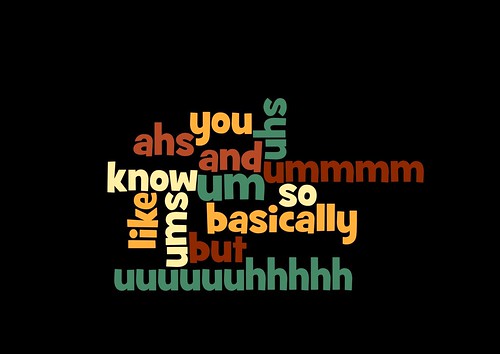
You don’t notice when people don’t say “um” and “uh” and “you know.” When they do, though, they can really interfere with listening because they break the flow. Those are the obvious “vocalized pauses,” but there are others that will interfere for a different reason, and they can be even harder for a speaker to notice and eliminate.
The first step in dealing with them is recognizing them. Let’s look at three classes of vocalized pauses. Continue reading

Every speech is unique, as is every speaker. But the problems that cause speeches to crash are amazingly consistent. I have listened to over 24,000 speeches in my life. Probably 80 percent of the “bad” speeches resulted from one of the following problems. Continue reading

I didn’t really mean to stop writing. But I haven’t posted anything here since July. I actually wrote quite a bit since then, but nothing that struck me as worth publishing. There are 25 posts sitting in draft mode. In November, I wrote a skeleton of a post that said, “This is probably my last post.” I remember what was happening then. I had just discovered that my aunt had died–a year earlier. And a favorite cousin had also died–two years earlier.

I’ve put off commenting on this controversy, mainly because I have no interest in taking part in whatever the current social media flavor-of-the-month might be. But this particular one is continuing, and the discussion almost inevitably neglects to take into account a basic principle of communication, a neglect that not only fuels controversy, but fuels violence.
Alfred Korzybski in particular made us aware of this basic principle through his insights in the field that became known as general semantics.
General semantics involves a lot of insights, actually, but the one I’m focusing on today is this: the map is not the territory.
Continue reading

I have it lucky, in a way. Because I post on a blog, I can assume that if you are here, it’s OK for me to give advice. After all, if you don’t want it, you won’t come here in the first place–unless you just like hearing me bleed!
Perhaps you have noticed (as have I, though I am still working on remembering what I’ve noticed) that face-to-face advice works differently. Just because people have problems doesn’t mean they are open to your advice. Even if they say, “I have a problem,” they may still simply seek a sympathetic ear rather than advice.
Why People May Not Want Your Advice not only looks into the psychology of the phenomenon, but also offers solid advice about how to avoid giving too much advice. But don’t go looking at it unless you actually want advice!
Photo from Flickr user GotCredit under CC attribution license.
